JOIN MZTA
What You Can Do
Site Map
|
Consider a National Cultural Trail
The main goal of the Great Plains to Interior Highlands Trail - the Link Trail - is to connect the Appalachian Trail and the Continental Divide Trail. Its purpose is to provide new challenges for trekkers and thru-hikers, as well as casual adventurers. As an intermodal trail, it is planned to include a route for bicycles for leisure riding and competitive tours. Another intention is that sections of the trail will serve the interests of wheelchair athletes and others out for exercise.
In planning a route that will pass near populated areas, while seeking corridors through sparsely populated, historic and scenic regions, it became obvious that the trail should serve automobile travelers (and to possibly be a proving grounds for electric-powered and autonomous vehicles) in order to guarantee access for as many people as possible and to provide benefits to local communities. The planned route was clearly diverse in its environments and offered very interesting scenery. But it is also exceptionally unique for the historic and modern populations it will serve and the large percentage of American iconic places it will visit.
There is not an official designation available for "National Cultural Trail," but that is not necessarily the goal of the effort. If there were, however, the Link Trail would be very high on the list, possibly at the top, to get the moniker.
While the first goal was to develop a National Recreation Trail - initially planned to connect Dallas-Fort Worth with the unique mountain ranges across the Red River (for hikers and cyclists), utilizing the Northeast Texas Trail and other segments to be established - it was perhaps the larger goal - to connect the Appalachian Trail to the Continental Divide Trail - that inspired a new vision for a new kind of national trail to emerge - an intermodal trail serving many diverse cultural interests.
On the east end is the nearly century-old Appalachian Trail (along with Indian trade routes, the 200-year-old Georgia Road, and the Trail of Tears), and on the west end is the two centuries-old annual pilgrimage to Chimayo and the more than four centuries-old Camino Real. The histories and lifeways of the indigenous peoples who inhabited and continue to live across the span of the trail are widely varied, as described by the people themselves, written in historic texts, and seen today through diverse traditions, languages and architecture.
Sites on and near the route are important to education and understanding of Spanish conquest, colonization, the American Revolution, Indian removal and the tragic legacies of the Trail of Tears and the Indian Wars, the Civil War, the Civil Rights Movement, industrial and technological changes, the Dust Bowl and Great Depression, waves of migration of immigrants and refugees, and many other national historic events.
The wide variety of topics that make the Link Trail a great source of cultural and educational interests include: history, archaeology, architecture, agriculture, food traditions, social and political movements, religions, social life and entertainment, music, forms of art, health, recreation, transportation, trade and business trends, economics, and much more.
The photo galleries in this section will provide an overview of fascinating locations (on and near the trail) and the many cultural interests found there.
Also see pictures featured in Chapter Organizations.

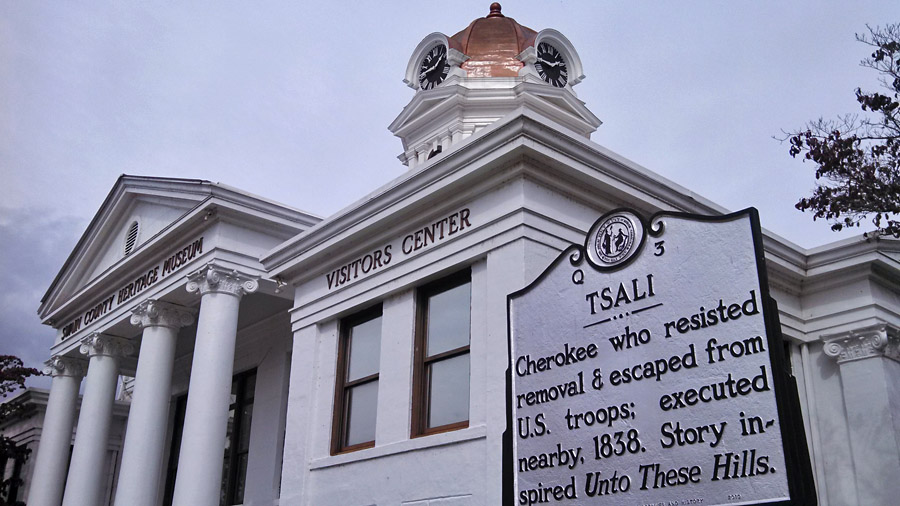
The important histories of America's indigenous peoples are found on the Link Trail.

Several of the nation's oldest National Parks - Hot Springs, Great Smoky Mountains, and others - are on the trail.

Parks provide pleasant leisure spaces and excellent places to visit.

A pedestrian and bicycle bridge crosses the Tennessee River near the Hunter Museum of American Art.

A 1908 train station on the Southern Railway serves as a hotel named for the Chattanooga Choo Choo.

Public art and support for small business are important means to revitalize many cities' Main Streets on the Link Trail.

Interesting and unique activities are available through the efforts of local people.

Many distinctly American music forms were created in cities on the trail.
Forms of music rooted (created, innovated and preserved) on the Link Trail include: Bluegrass, Appalachian Folk, Old-world Ballads (English/Irish/Scottish), String Band Music, Southern Rock, Country, Blues, Soul, Rockabilly, Gospel, Americana, Folk, Old-time Music, Ragtime, Irish/Celtic Folk, Fiddle Music, Western Swing, Cowboy, Trail Songs, Honky Tonk, Red Dirt, Outlaw Country, Alternative Country, Free Jazz, Powwow Drum Music, Indigenous/Native American Music, Rock 'n' Roll, Classic Rock, Polka (Czech/German), Matachines Dance Music, Spanish Sacred/Church Choir, Nuevomexicano Music, Mariachi, Flamenco and more.

Memphis boasts the legendary recording studios and labels - Sun, Stax and others - that brought new music to mass audiences around the wold.

Connected by the Mississippi River and historic U.S. Highway 61, cities like New Orleans, Natchez, Baton Rouge and Clarksdale have had an important symbiotic cultural exchange relationship with many of those on the Link Trail.
Music genres and styles predominantly established near the trail in communities with unique connections include: Jazz, Dixieland, Boogie Woogie, Rhythm and Blues, Funk, Brass Band, Psychedelic Rock, Cajun, Zydeco, Swamp Pop, Tejano, Tex-Mex, The Tulsa Sound, and more.

Music and iconic arts have provided long-standing occupations and cultural interests in historic cities connected to the Link Trail.

Connectivity of cultures and their artforms have created common interests and social life along the trail.

The Link Trail is lined with many iconic names and places, along with mant trends, artforms and social movements.

Films made about the places, peoples and environments on the Link Trail reveal a wide diversity of cultural interests.
Some films based on cultural and generational topics along (or related to) the Link Trail include: Mystery Train, Milagro Beanfield War, Mississippi Masala, Rosalie Goes Shopping, True Stories, Thelma and Louis, Driving Miss Daisy, Fried Green Tomatoes, Paris, Texas, The Road to Galveston, My Cousin Vinnie, Liningrad Cowboys Go America, and more.

Food traditions and entertainment are an important part of regional identities all along the trail.

Many historic places are dependent on visitors' interest and support, not only to stay in business, but to preserve old architecture and artistic details, and provide unique visitor experiences and services.

There's no shortage of fun, good food and drinks waiting on the trail.

Many trail communities offer an informal atmosphere that is appealing and highly suitable for casual travelers, like hikers, cyclists and families on road trip adventures.

Impoartant places on the trail, like the historic Daisy Theatre - the first Black-owned entertainment facility on Beale Street - are in need of support from a culturally knowledgable, interested and active public.

Prominent American historic sites, like the Lorraine Motel - site of the 1968 assassination of Civil Rights leader Dr. Martin Luther King - are preserved on the Link Trail.

The location is active in education and has grown into a major National Civil Rights Museum.

Many of the most important Civil Rights historic sites, including Atlanta, Memphis, Little Rock, Selma, Montgomery, Jackson and New Orleans are on or near the trail through a network of important and connected places and routes.

The old Natchez Trace crosses the Link Trail and provides interesting connections and possibilities to visit many important historic events and places.

Fascinating history is learned and experieanced in communities that make excellent short detours up and down routes like the Natchez Trace, Mississippi River and other significant travel and trade ways.

Many of the nation's cultural history sites are fragile and endangered, including this music history site on the Mississippi Blues Trail that was destroyed by fire in Port Gibson.

Some of the nation's most substantial archaeological sites are accessible on and near the trail.

Even recreational pastimes like camping and "caravanning" (as vehicle camping was once called) have a unique place in our history and cultural exchange, and developed substantially in places on the Link Trail.
The Link Trail provides a wide array of recreational, cultural and educational interests, along with travel services and local resources along the proposed multi-modal corridor (serving automobiles, bikes, foot travel, wheelchairs, potentially autonomous vehicles, and more). See a preliminary assessment of the almost unlimited opportunities for adventure travelers and tourists. View more photos, along with the efforts and development possibilities for Chapter Organizations along the Link Trail.
More image galleries and updates will be provided. Stay tuned!
Return to Top of Page
|